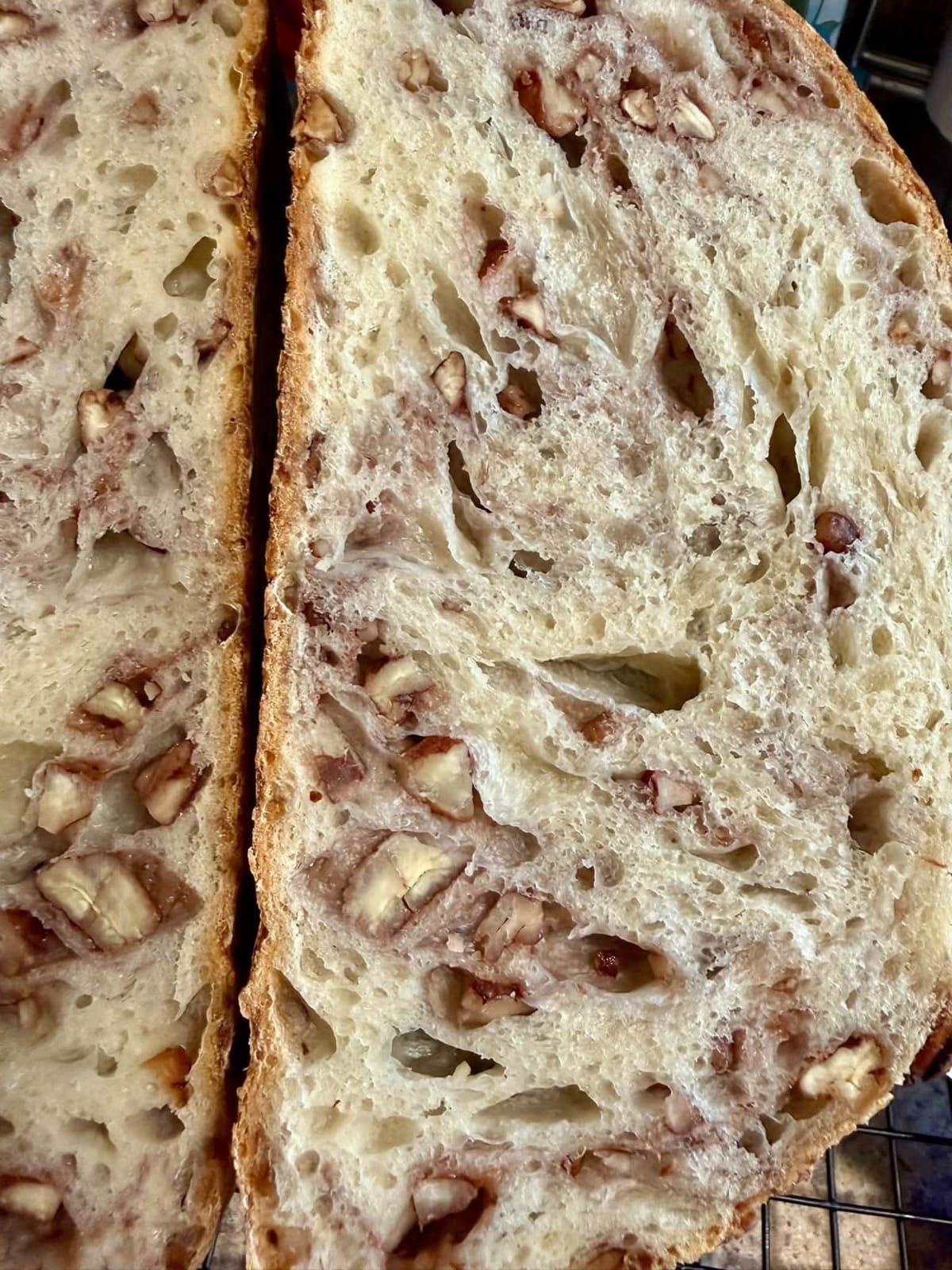
There is something special about slicing into a homemade sourdough loaf and seeing a airy, open crumb studded with toasted pecans. This pecan cinnamon sourdough has a crackly golden crust, a soft and slightly chewy interior, and gentle tang from the natural fermentation. The pecans add buttery crunch, and a hint of cinnamon makes every slice feel cozy.
It is perfect toasted with butter at breakfast, paired with sharp cheese, or turned into the best French toast of your life. If you have baked sourdough before, this recipe will feel familiar. If you are new to it, the step-by-step instructions below will guide you.
Why You’ll Love This Recipe
- Bakery-style crust and crumb using only a Dutch oven and a home oven
- Natural fermentation, with no commercial yeast needed
- Toasted pecans for deep, nutty flavor and texture
- Easy to schedule, since the long rise happens overnight in the fridge
- Great for gifting, and it freezes well
Recipe at a Glance
- Prep time: 30 minutes active (plus fermentation)
- Total time: About 18 to 24 hours
- Bake time: 45 minutes
- Yield: 1 large loaf (about 12 slices)
- Difficulty: Intermediate
Ingredients
For the dough:
- 500 g (4 cups) bread flour
- 50 g (⅓ cup) whole wheat flour
- 400 g (1⅔ cups) lukewarm water
- 100 g (½ cup) active, bubbly sourdough starter
- 10 g (2 teaspoons) fine sea salt
- 1½ teaspoons ground cinnamon
- 1 tablespoon honey or maple syrup (optional, for balance)
For the add-ins:
- 150 g (1½ cups) pecan halves, roughly chopped and lightly toasted
For shaping and baking:
- Rice flour or all-purpose flour for dusting
- Parchment paper
Equipment
- Large mixing bowl
- Kitchen scale (highly recommended for sourdough)
- Bench scraper
- Banneton or a bowl lined with a floured towel
- Dutch oven with lid
- Sharp knife or bread lame
- Wire cooling rack
Before You Begin: Prepare Your Starter
Your starter should be active and at its peak, meaning it has doubled in size, is full of bubbles, and floats in a glass of water. Feed it 4 to 8 hours before mixing. A weak starter is the most common reason for a dense loaf, so do not rush this step.
Toast the pecans in a dry skillet over medium heat for 4 to 5 minutes, stirring often, until fragrant. Let them cool completely, then chop them into rough, bite-sized pieces. Toasting boosts flavor, and cooling prevents the nuts from warming your dough.
Step-by-Step Instructions
Step 1: Autolyse (30 to 60 minutes)
In a large bowl, mix the bread flour, whole wheat flour, and water until no dry flour remains. The dough will look shaggy. Cover and rest for 30 to 60 minutes. This rest lets the flour hydrate fully and begins gluten development without any kneading.
Step 2: Add Starter and Salt
Add the active starter, salt, cinnamon, and honey. Squeeze and fold the dough with wet hands for 2 to 3 minutes until everything is fully combined. The dough will feel sticky, which is normal for a well-hydrated sourdough.
Step 3: Bulk Fermentation (4 to 6 hours)
Cover the bowl and keep it at a warm room temperature, ideally 24 to 26°C (75 to 78°F). Over the next 4 to 6 hours, perform four sets of stretch and folds, spaced 30 minutes apart:
- Wet your hand and grab one edge of the dough.
- Stretch it upward gently, then fold it over the center.
- Rotate the bowl a quarter turn and repeat until you have gone around four times.
Add the pecans during the third set. Sprinkle them over the dough and fold them in as you stretch. Adding them later protects the gluten structure from being torn by sharp nut edges.
After the final fold, let the dough rest undisturbed. Bulk fermentation is done when the dough has grown by about 50 to 75 percent, feels airy and jiggly, and shows bubbles along the edges and surface.
Step 4: Pre-Shape and Bench Rest
Turn the dough onto a lightly floured surface. Using a bench scraper, gently fold the edges toward the center to form a loose round. Rest it, seam side down, for 20 to 30 minutes, covered with a towel.
Step 5: Final Shaping
Flip the dough over so the seam side faces up. Fold the bottom third up, then the top third down, like a letter. Fold in the sides, then roll the dough toward you to create surface tension. Aim for a tight but not torn skin.
Dust your banneton generously with rice flour. Place the dough seam side up in the basket (or seam side down if you prefer a rustic, ear-free look), and pinch the seam closed.
Step 6: Cold Retard (8 to 14 hours)
Cover the banneton and refrigerate overnight. This slow, cold proof builds the signature sourdough tang, improves the crust color, and makes the dough much easier to score.
Step 7: Preheat the Oven
Place your Dutch oven with its lid inside the oven and preheat to 250°C (480°F) for at least 45 minutes. A properly heated pot is the secret to oven spring.
Step 8: Score and Bake
Take the dough straight from the fridge. Turn it out onto a sheet of parchment paper, and dust the top lightly with flour. Score the loaf with one confident, slightly angled slash about 1 cm deep.
Carefully lift the parchment into the hot Dutch oven, cover, and bake:
- 20 minutes at 250°C (480°F) with the lid on, to trap steam
- Remove the lid, reduce to 220°C (430°F), and bake 20 to 25 minutes more, until the crust is deep golden brown
The internal temperature should reach about 96 to 99°C (205 to 210°F).
Step 9: Cool Completely
Transfer the loaf to a wire rack and let it cool for at least 1 hour before slicing. The crumb is still setting as it cools, and cutting too early can make it gummy. Listen for the crackling sound of the crust, which is the best reward for your patience.
Pro Tips for Success
- Use a kitchen scale. Sourdough is sensitive, and grams are more reliable than cups.
- Watch the dough, not the clock. Fermentation time changes with room temperature. A warm kitchen speeds things up, while a cool one slows it down.
- Do not skip toasting the pecans. Raw nuts taste flat and can turn bitter during the long bake.
- Chop pecans roughly. Pieces that are too small disappear in the crumb, while whole halves tear the dough.
- Score with confidence. A quick, decisive cut gives a better ear and bloom.
- Keep the dough cold when scoring. Chilled dough holds its shape and cuts cleanly.
Troubleshooting
My loaf is dense. Your starter may have been weak, or the dough was under-fermented. Wait until the dough is airy and visibly grown before shaping.
The crust is too pale. Bake the final 10 minutes with the lid off for longer, or raise the oven temperature slightly.
The dough is too sticky. Wet your hands rather than adding extra flour, and use a bench scraper. Stickiness is normal in high-hydration dough.
The pecans burn on the crust. Make sure the nuts are mixed into the dough rather than sitting on the surface.
Flavor Variations
- Cinnamon swirl: Before the final shape, sprinkle the dough with a mix of cinnamon and brown sugar, then roll it up for a swirled interior.
- Walnut or hazelnut: Swap the pecans for walnuts or toasted hazelnuts.
- Raisin pecan: Add 100 g of soaked, drained raisins with the nuts.
- Maple pecan: Replace the honey with maple syrup and add a pinch of nutmeg.
Serving Suggestions
This bread shines in many ways:
- Toasted with salted butter and a drizzle of honey
- Spread with cream cheese and sliced figs or apples
- Served alongside a cheese board with sharp cheddar or brie
- Turned into decadent French toast or bread pudding
- Used for a turkey, apple, and brie sandwich
Storage
- Room temperature: Store cut side down on a cutting board, or in a paper bag or bread box, for up to 3 days. Avoid plastic, which softens the crust.
- Freezer: Slice the cooled loaf, wrap tightly, and freeze for up to 3 months. Toast slices straight from frozen.
- Refresh: Revive a day-old loaf by warming it at 175°C (350°F) for 8 to 10 minutes.
Nutrition (Approximate, Per Slice)
Roughly 190 calories, 7 g protein, 31 g carbohydrates, 5 g fat, and 2 g fiber. Values vary with the exact ingredients used.
Final Thoughts
Baking pecan cinnamon sourdough takes time, but most of that time is hands-off, and the result is truly rewarding. With its crackly crust, tender crumb, and toasted nutty bursts in every bite, this loaf is one you will return to again and again. Once you have the rhythm down, it becomes a relaxing weekend ritual.
If you try it, let me know how your loaf turned out in the comments, and share a photo of your crumb shot. Happy baking!

